
How Presbytery Is Shaped
Presbytery Shape
The Presbytery is part of the Church and the Mission of the Church is the Mission of Christ.
Presbytery exists in and through its members, who are drawn from and serve diverse communities: coastal, island, rural, and urban. It is convened by its Moderator and served by its staff (Presbytery Clerk, Administrator, and others).
The Business of Presbytery is arranged by its Business Committee. The Business Committee coordinates the work of Presbytery and, when necessary, appoints members of Presbytery to carry out the exercise of oversight and discipline.
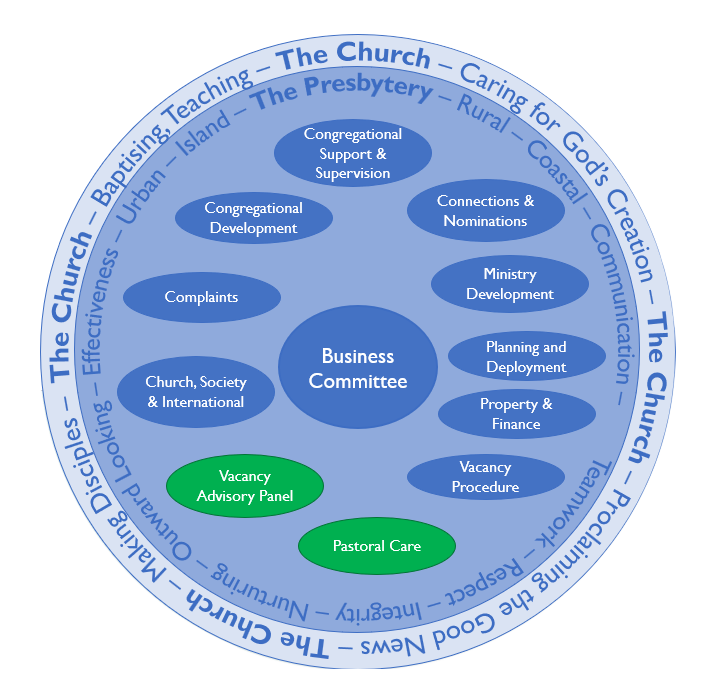
Presbytery Committees
The Presbytery's work is primarily delegated to its committees. There is an expectation that Standing Committees will report to each Presbytery Meeting as necessary (note the Complaints Committee sends its output to the Congregational Support and Supervision Committee).
Standing Committees
- Business Committee
- Church, Society, International Committee
- Complaints Committee
- Congregational Support and Supervision Committee
- Congregational Development Committee
- Connections and Nominations Committee
- Ministry Development Committee
- Presbytery Planning and Deployment Committee
- Property and Finance Committee
- Vacancy Procedure Committee
Support Committees
- Pastoral Care Committee
- Vacancy Advisory Panel
Remits of Committees
In the conduct of their business all committees will work in the spirit of the Presbytery’s agreed set of values. Committees are encouraged to share with each other, and with Presbytery as a whole, examples of good practice and stories of positive engagement between local expressions of church and, where appropriate, and with sensitivity, to publicise stories of positive engagement between local expressions of church and local communities.
Note that Standing Committees are expected to report in writing to each meeting of Presbytery.
Standing Committees
Business Committee
The Business Committee shall
- Arrange meetings of Presbytery, coordinate the work of Presbytery through its standing committees, allocate General Assembly remits to its standing committees and generally support the smooth running of the business of Presbytery, all so as to ensure that Presbytery carries out its duties as a Court of the Church.
- Keep under review the format, agenda and frequency of Presbytery meetings.
- Provide an opportunity for Committee Conveners to understand what each other is working on and whether there is potential overlap or potential for working collaboratively.
- Appoint members of Presbytery to the Connections and Nominations Committee.
- Exercise oversight of Presbytery finance, including working with the Treasurer to prepare an annual budget.
- Prepare Presbytery’s Annual Report and Accounts.
- Process and make recommendations to Presbytery in regards to applications to Presbytery Funds.
- Oversee all aspects of communication within Presbytery, working with the Communications Officer.
- Ensure that OSCR regulations and all relevant matters relating to civil and ecclesiastical legislation are fulfilled by Presbytery.
- Maintain responsibility for risk assessment, risk management and maintain a Risk Register on behalf of the Presbytery.
- Maintain a Staffing Group with responsibility for Presbytery local staffing matters, including contracts, terms and conditions, and recruitment.
- Maintain a Code of Conduct for the Presbytery, ensuring it is reviewed annually and respond to potential breaches of the Presbytery Code of Conduct taking whatever action may be necessary if a material breach has occurred.
- Be the primary contact for the Communications Officer and the Treasurer, and the committee through which they report to Presbytery.
Church, Society, International Committee
The Church, Society, and International Committee shall:
- Provide a forum for relevant matters raised by the Church of Scotland’s Faith Action Programme Leadership Team, Social Care (known as CrossReach), Public Life and Social Justice Programme Group (political action) or their equivalents.
- Facilitate Presbytery engagement with and comment on local, national, international, political and social issues where appropriate, guided by the Five Marks of Mission.
- Encourage and promote the work of LiFT, the Guild, CrossReach, Christian Aid, and Eco-Congregation Scotland.
- Provide support for international partnerships between local expressions of church in Presbytery and those overseas, keeping Presbytery informed of partnership developments.
- Support the work of ecumenical bodies locally and nationally, promoting local inter-church initiatives and activities.
- Support interfaith work, promoting the work of Interfaith Scotland and local initiatives and activities.
- Foster links with social care agencies regionally.
- Support the transformation of unjust structures locally, regionally and worldwide.
- Work with the Property and Finance Committee and any other relevant committees in responding to the challenge of climate change and the development of church buildings.
- Support Prayer Promoters in nurturing prayer for all aspects of mission and outreach locally and further afield.
- Receive reports from the Presbytery nominated Local Authority representatives, and work with the national Education and Schools Group, liaising with the Congregational Development Committee where necessary.
Complaints Committee
The Complaints Committee shall:
- Act as the Presbytery’s Complaints Committee.
- Deal with matters arising under the Church’s discipline legislation.
- Report to Presbytery as and when required through the Congregational Support and Supervision Committee.
Congregational Support and Supervision Committee
The Congregational Support and Supervision Committee shall:
- Encourage and support congregations in designing congregational Action Plans.
- Review congregational Action Plans in accordance with the Presbytery Mission Plan Act, 2021 (Act VIII 2021).
- Conduct post-adjustment checks on congregations and offer support as necessary.
- Organise the annual inspection of Congregational Records (except for Property Registers, Manse Condition Schedules, Annual Report and Accounts and Ministers’ Logbooks).
- Oversee data protection requirements for the Presbytery and congregations.
- Support and encourage Session Clerks, Treasurers, and other congregational office-bearers.
- Be the lead agency for Safeguarding in the Presbytery; ensuring that Kirk Sessions implement the Church’s Safeguarding Policy and adhere to the Code of Good Practice; recruiting and supporting Presbytery Safeguarding trainers and coordinators; providing training and support for Safeguarding in local expressions of church.
- Maintain a Superintendence Sub-Group to which all matters of superintendence in terms of acts of the General Assembly, reports of the Complaints Committee, and issues of conflict in congregations, are referred.
- Be the primary contact for the Congregational Support Officer and the Presbytery Safeguarding Contact and, the committee through which they report to Presbytery.
Congregational Development Committee
The Congregational Development Committee shall:
- Promote and support the mission and renewal of local congregations, including through fresh expressions of Church (liaising with Presbytery Planning and Deployment where appropriate) and outreach appropriate to the local context.
- Promote and support faith formation and discipleship within congregations.
- Promote and support the development and resourcing of worship (including music and the arts)
- Promote and support work with children, youth and under-40s.
- Promote and support chaplaincies appropriate to local needs.
- Promote and support prayer initiatives in conjunction with the Prayer Promoters.
- Encourage and support congregations in implementing Congregational Action Plans.
- Organise training and development opportunities in respect of its remit and facilitate communities of learners across the Presbytery areas.
- Develop, promote and support a Presbytery ‘Local Worship Leaders’ scheme and maintain a list of Local Worship Leaders approved by such a scheme or under a former Presbytery’s scheme.
- Support School Chaplains and local expressions of Church in resourcing the Church's work in schools across Presbytery, liaising with the Church, Society, International Committee with respect to areas of work raised by Presbytery representatives on Local Authority committees.
- Be the primary contact for the Mission Development Officer, the Mission and Discipleship Development Worker (MDS) and the Youth Development Officer.
Connections and Nominations Committee
The Connections and Nominations Committee shall:
- Build connections and relationships across Presbytery through activities which encourage good communications and foster friendship and collegiate working, having always in mind Presbytery’s agreed values.
- Bring forward to Presbytery names for appointment to committees and Presbytery positions, including but not limited to, the Moderator of Presbytery and the Conveners of committees.
- Facilitate membership of Presbytery including nominating balancing and additional elders, and corresponding members.
- Arrange an annual induction event for new members of Presbytery in conjunction with the Business Committee.
Ministry Development Committee
The Ministry Development Committee shall:
- Support the Recognised Ministries of the Church of Scotland.
- Oversee recruitment, selection and training for all Recognised Ministries in the Church of Scotland.
- Nominate as Candidates for Recognised Ministries those who have been accepted as Prospective Candidates by an Assessment Conference.
- Support the Readership including arranging and assessing placements and supervision for those in training for readership and ongoing support for Readers already set apart.
- Encourage opportunities for those in the Recognised Ministries to develop relationships for mutual support.
- Ensure appropriate oversight of all members of local ministry teams including MDS staff is in place, and to arrange a network of support for line managers and supervisors.
- Oversee Ministers’ Log Books.
- Approve arrangements for in-service Training, study-leave, and a study and reflection programme for Ministers of Word and Sacrament in their first five years.
Presbytery Planning and Deployment Committee
The Presbytery Planning and Deployment Committee shall:
- Promote a positive policy for the mission of Presbytery by taking account of changing congregational resources and social patterns as they relate to the Presbytery Mission Plan Act, 2021 (Act VIII 2021).
- Oversee the implementation and regular review of the Presbytery Mission Plan, including, among others, considering the priorities for growth and renewal of local congregations, outreach to younger generations, the incorporation of fresh expressions of Church and new worshipping communities, and the aim of financially sustainable congregations.
- Oversee the deployment of ‘Attached’ Readers and Ordained Local Ministers.
- Recommend for approval locally funded Ministry appointments.
- Support those creating MDS posts and locally funded posts, including assisting with job descriptions and appraisal process to ensure consistency.
- Receive and consider all requests for adjustments to parish boundaries and negotiate adjustments with Kirk Sessions.
- Review and advise on Seeds for Growth Fund applications.
Property and Finance Committee
The remit of the Property and Finance Committee shall be divided into two sections.
Acting in connection with property matters Property and Finance Committee shall:
- Undertake annually a due diligence examination of Property Registers and Manse Condition Schedules of church properties within the Presbytery bounds.
- Be the Committee through which the Presbytery Buildings Officer reports to Presbytery, and to set and oversee the operational direction of the work of the Presbytery Buildings Officer on a day-to-day basis. [Note: Line management of the Presbytery Buildings Officer is exercised by the General Trustees.]
- Organise the ten-yearly professional survey and interim surveys of all buildings within the Presbytery bounds in accordance with the remit provided by the General Trustees from time to time.
- Arrange the required inspection of manses in times of vacancy.
- Provide oversight and guidance with regard to all church properties within the Presbytery bounds, in particular ensuring that congregations obtain the necessary permissions, including the permission of Presbytery and the General Trustees as appropriate, before undertaking programmes of work.
- Advise and help process applications for grants and loans in relation to property work.
- Work with the Presbytery Buildings Officer in advising on good practice and provide information on Health and Safety matters.
Acting in connection with finance matters the Property and Finance Committee shall:
- Undertake the annual inspection of congregational accounts in accordance with the regulations of the General Assembly concerning congregational finance and the requirements of the Office of the Scottish Charity Regulator.
- Arrange for the completion of financial schedules in connection with vacancies.
- Liaise with congregations in relation to their Giving to Grow allocations and to investigate any Giving to Grow shortfalls.
- Provide the Presbytery Treasurer with such statistics as are necessary for calculating annual congregational assessments/dues, and to determine annual congregational assessments/dues.
- Inform and encourage congregations in all aspects of stewardship including the use of the materials provided by the Stewardship and Finance Department of the Church and the advice and assistance of the Church’s Stewardship Consultants.
Vacancy Procedure Committee
The Vacancy Procedure Committee shall:
- Fulfil the responsibilities of Presbytery in relation to any relevant Vacancy Procedures legislation, including the Call, Election and Appointment of Ministers of Word and Sacrament Act (Act II 2025), in relation to vacant charges, including the question of granting of Permission to Call.
- Consist of at least three and not more than seven members and includes a Convener, Depute Convener and Clerk, the latter of whom need not be a member of the Committee but may be the Presbytery Clerk.
- Fulfil the responsibilities of Presbytery in relation to the appointment of Interim Moderators for those congregations who are without an inducted Minister of Word and Sacrament.
Support Committees
Pastoral Care Committee
The Pastoral Care Committee shall:
- Develop and maintain a suitable model of pastoral support for the Presbytery, which offers choices in provision reflecting the differing needs of each individual.
- Oversee the provision of pastoral care to the Ministers, Deacons, OLMs, auxiliary Ministers, Readers, Ministry Development Staff, which operate within its bounds.
- Oversee the provision of pastoral care as required for candidates for all ministries during their training and up to their appointment or ordination.
- Ensure that adequate support is given through named individuals to those in ministry in their first five years or who have come through familiarisation.
- Oversee the provision of pastoral care to those involved in the discipline or complaints process.
- Inform Presbytery of the importance of pastoral care for those in ministry posts and addressing the barriers which exist in asking for support.
- Signpost on a regular basis the pastoral support available through Ascend and other suitable organisations.
Vacancy Advisory Panel
The Vacancy Advisory Panel shall:
- Consist of a pool of at least three persons.
- Provide advice and support to congregations in a vacancy, and may do so individually or collectively save as referred to in section 28 of Act 11 2025 where the whole Advisory Panel shall act.