
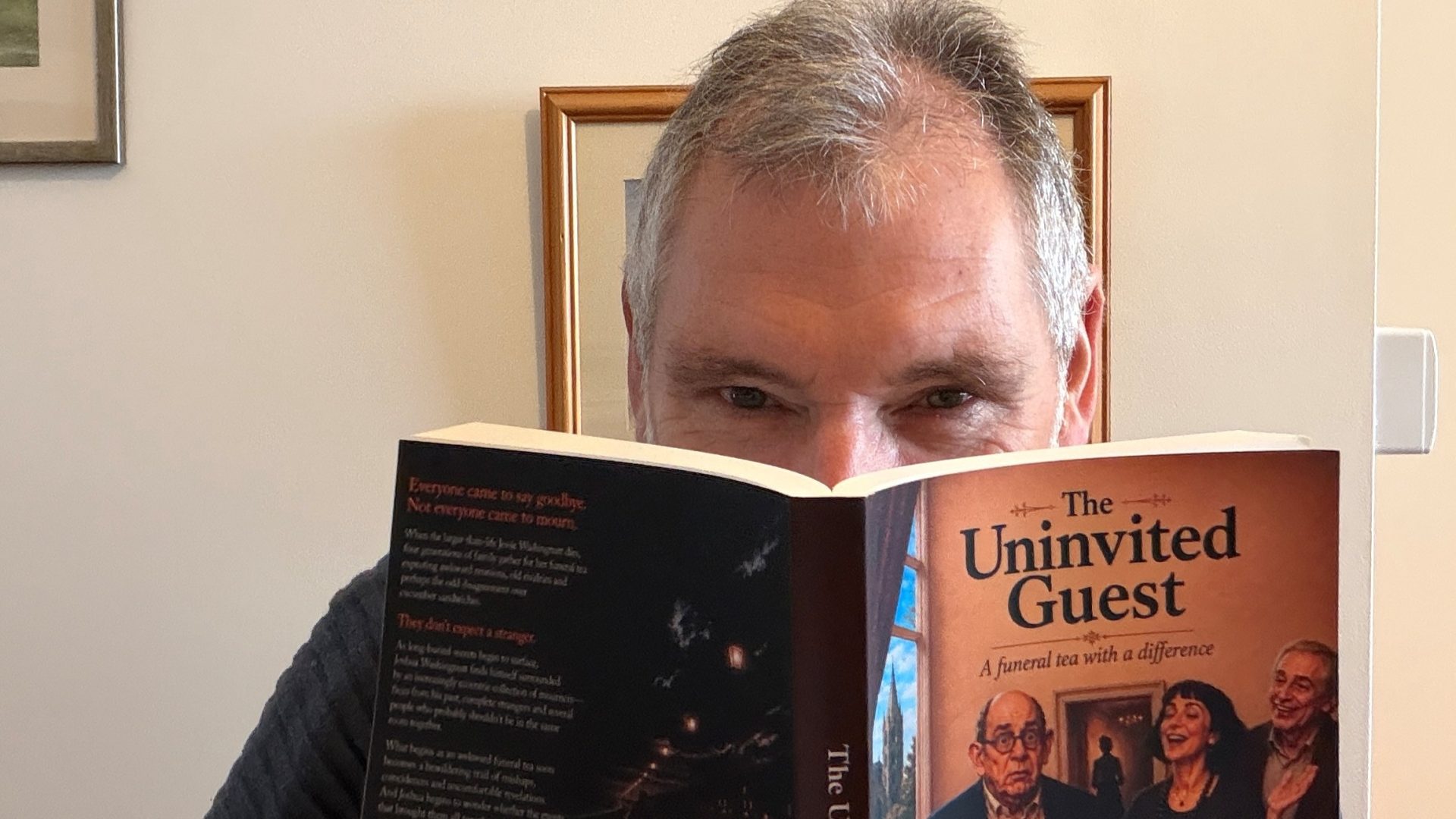
by Douglas Stevenson, retired minister of Cullen and Deskford, now Seafield Parish Church of Scotland.
For many years I had a book in me. Unfortunately, it showed remarkably little enthusiasm for coming out.
I spent much of my working life in the Church of Scotland, completing my ministry in Cullen and Deskford in the north-east before eventually exchanging parish life for the rather different world of psychotherapy. Somewhere along the way I accumulated stories — not stories about particular congregations or individuals, I should hasten to add, but the sort of incidents, characters and absurdities that anyone who has spent long enough around churches will probably recognise.
Eventually, those ingredients found their way into a novel.
The Uninvited Guest: A Funeral Tea with a Difference began with a fairly simple idea: what might happen if a group of people gathered after a funeral and somebody turned up who wasn't supposed to be there?
The central character is Joshua Amos Washingnutt, a Church of Scotland minister whose life has not unfolded quite according to plan. Joshua is forty-one, anxious, somewhat accident-prone and blessed — if that is the appropriate word — with unusually prominent ears. By the time we meet him properly, his ministry is in trouble, his marriage is struggling and his formidable 101-year-old grandmother, Jessie, has died.
Her funeral brings the family together at a hotel in Ayr.
And then the guests begin to arrive.
Some belong there. Some probably don't. One most definitely wasn't invited.
What follows is part mystery, part comedy and part exploration of the strange things human beings carry around with them: faith, doubt, guilt, relationships, memories and the versions of ourselves we would sometimes rather leave undisturbed.
Although the book is fiction, my years in ministry inevitably supplied some of its raw material. Clergy will probably recognise the occasional boiler that chooses the least convenient moment to stop working, the church meeting that develops a life of its own, and the uncomfortable truth that the minister is not always the wisest person in the room.
There is also a certain amount of theology — although I should probably reassure former colleagues that nobody is required to agree with it.
At heart, however, I think the book is about people. Ministry gave me the enormous privilege of being allowed into people's lives at moments of joy, grief, absurdity and crisis. My later work as a psychotherapist only strengthened my fascination with the stories people carry and the complicated ways in which our past continues to accompany us.
Writing the novel gave me permission to play with all of that.
And once Joshua Washingnutt had arrived, he proved remarkably reluctant to leave. In fact, another story involving him is already beginning to take shape.
The Uninvited Guest is now available in Kindle and paperback editions through Amazon, with a hardback edition on the way. Whether it will ever become a film remains doubtful. Although I remain available for negotiations.
Take a sneak peek:
“Nearly there—these intimations may last longer than the sermon,” he said with a chuckle. Nancy Cross’s face turned puce. To her, the Word of God should last at least forty minutes, or it wasn’t worth attending. The last time she'd heard such a sermon was in the 1950s under Rev Jeremiah Unsworth, MA.
“The Guild is planning a bus trip to Rothesay. There are still seats available. Speak to Brenda Williams after the service if interested. One of our travellers will be Mrs Jessie Washingnutt. Many of you know Jessie—a remarkable woman who recently celebrated her 101st birthday.”
Applause and murmurs.
“Jessie was born in Rothesay. I’m sure she'd love an afternoon back there. And finally…” Kenny flashed a broad grin. “What do you call an Egyptian who drives a taxi in Glasgow?”
Nancy Cross's blood pressure surged. The congregation murmured: “Don’t know.”
“Toot-an-come-oot.”
Laughter erupted.
“Right, enough joviality. We’re here to worship. Let us sing to God’s praise and glory with hymn thirty-three: Let Us with a Gladsome Mind.”