
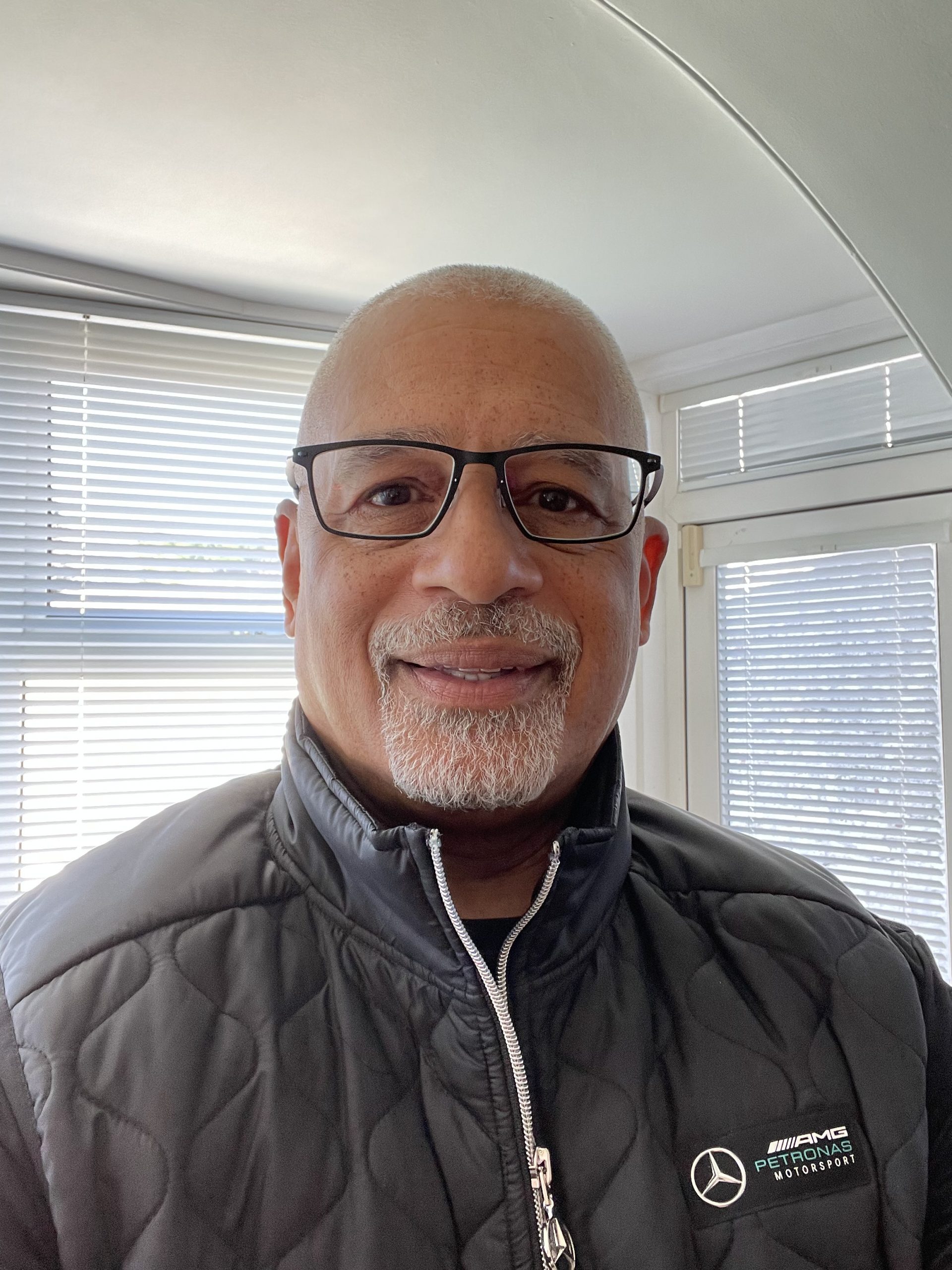
Rev Dr Robert Smith - Mission Development Officer
Robert is the presbytery's Mission Development Officer and he is here to support you in all things mission!
He can bring a mission-focused workshop to your church, like he did in Aboyne. Watch the video to get the feel for the day →
Robert is happy to work with you on developing mission:
01224 049937
rsmith@churchofscotland.org.uk
“As I have focused on meeting with congregations to learn more about their ‘shape’ and get a feel for what their mission efforts have been and could be in the future, my efforts really have been to come alongside, listen to them and let them know that I am a resource for them and that includes sharing with congregations about the Seeds for Growth programme and other forms of support. As congregations come to grips with the still ongoing adjustments in their parishes and settle into the many changes we face, which are significant, the focus on mission remains; and now more and more congregations are taking up the challenge to discover, imagine and work together to build mission together.”
About Robert
 Hello, I am Rev Robert Smith and in January 2024 I was appointed as the Mission Development Officer with the Presbytery of the North East and the Northern Isles.
I’ve lived in Aberdeen for just over 20 years but grew up in Alaska in the US. I completed my theological education at Aberdeen University, met a girl, got married and my wife and I are raising 2 boys here.
Prior to taking up this post, I was Minister of Word and Sacrament with the Church of Scotland here in Aberdeen for just over 10 years. It has been an honour to first serve the congregation of Rubislaw Parish Church and latterly, the congregation of Fountainhall Church, which was formed 1 June last year as the result of a four congregation union.
It has been challenging and rewarding, exhausting and fulfilling and I have been blessed by the many relationships it has been a real gift for me to enjoy and continue to hold dear. Now, I am looking forward to a different challenge which is to help stimulate and develop the understanding and practice of mission across our vast, new presbytery.
At its most simple, I believe that mission comprises all those things we do as Christians that tell of the amazing love of God in Jesus Christ … wherever we are. I don’t believe mission is one size fits all; it is shaped by who we are and where we are. Nor is mission a tick box exercise; it is a lifestyle, dynamic and evolving. And I don’t believe mission is a formula to be solved; it is creative and energetic.
So, in my new role, I’ll be encouraging us to ask good questions about who we are, who are the communities we serve, what are the resources we have and what are some new resources we can access going forward. What are the things we do well? What are new things we might do and what might we need to change going forward?
I look forward to learning from you about what mission might look like in your communities as I work to understand how best to support you thrive missionally.
That’s enough from me now. I just wanted to say hello and let you know a bit about myself and what I’ll be doing as Mission Development Officer.
I can be reached via email, Teams landline or mobile.
rsmith@churchofscotland.org.uk
Teams Phone 01224 049 937
Mobile 07563 878 741
Please don’t hesitate to get in touch.
Robert
Here are some Mission Resources:
ACORN
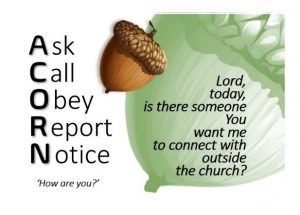 ACORN is an acronym: A – Ask, C – Call, O – Obey, R – Report, N – Notice. It’s a small and simple initiative to help believers step out, follow God, connect with others and then share what God is doing with others in the church.
ACORN is a movement that seeks to connect Christians with the work God is doing in others through caring conversation.
Here is what Paul Haringman, ACORN National Director, shared with us:
"Can you imagine your regular church folks having meaningful conversations with others about God, all the time? I can, I am seeing it, every day. Acorn really works, cause it isn’t a programme. We have seen so many people in our churches changed."
If anyone is interested in starting an ACORN group or knowing more about ACORN, please contact Paul Haringman at paulharingman.mission@gmail.com
Read more about ACORN in this article: https://navigators.co.uk/blog/2024/01/11/i-had-no-idea-being-an-alongsider-could-be-so-easy/
You can also read about ACORN here: https://ascend.churchofscotland.org.uk/2022/03/acorn-the-simplest-way-of-following-god-in-mission/
ACORN's YouTube
ACORN's Facebook
Many reasons why ACORN works
(These reasons have all come out of reflective experience, among people in various ACORN groups over a long period. The list is not complete as we keep finding out more that God is doing through Acorn.)1. It puts God in charge
ACORN is not based on a programme/vision/theory or an individual. It focuses us on listening to God first and although He is in charge, He wants to connect with others, through us. What an honour it is to adventure with Him, following His lead! As Jesus says in John 5:19, ‘I only do, what I see the Father doing’.
2. It puts mission first
Mission is often down the pecking order in our church lives. We tend to focus on fellowship, Bible study, teaching and group work first. ACORN resets that balance and puts John 3:16 front and centre in our lives. With many churches struggling to retain members, this helps address our connections outside church ‘head on’ and prioritises those who might be or feel far from Christ.
3. It acknowledges the here and the now
So many conversations in churches revolve around the future. ACORN focuses on what God is up to, here, now, among us. It concentrates on reality over potential and puts experience before possibilities. Improvement happens as He guides us.
4. Everyone can do it
ACORN moves ministry from a corporate church culture to individual disciples’ responsibility, as followers of Christ. It is something that all of us can do. It is not limited to age, experience, spiritual maturity or skillset (as many church ministries are). (See Nehemiah 3)
5. Faithfulness creates fruitfulness
We are called to be faithful, not successful. Many of us have failed to invite people to church activities and have become disappointed and fearful. We are called to simply obey and leave the results up to God. Over time we see people moving with Him and towards Him. As long as we plant and water, He will bring growth. (1Cor 3:6)
6. It deepens relationships
Often, over time, God calls us to keep reaching out to the same person. Experience shows that these relationships grow and deepen as we turn evangelism into a natural lifestyle. This results in having honest and profound conversations with people, often centring on their deepest needs and questions.
7. Questions over answers
We don’t need to be experts in apologetics or overt extroverts. ACORN allows for real conversations in which we are often asking far more questions than giving answers. This allows for open landscapes with people where we search for God together.
8. No need for resources
There is no need for a building, any resources, budgets, marketing, strategic decisions, or perhaps even leadership permission. It bypasses many limiting church structures. One person asks God to reveal one other person. We then call, write or visit. We might ask, ‘How are you?’ and prayerfully find out what God is doing in a situation. A small group then reports and notices what God is doing. That’s it, that’s all. Groups can easily split and multiply, as it is a ‘round the table’ experience, rather than any kind of leadership-driven model.
9. It suits anyone’s lifestyle
As there is no great need for resourcing, there is also no need to build in lots of space in our diaries. Experience tells us that we might need to make time to contact a person, but very often they call us, or we meet them at the supermarket. God uses the gifts He has given us, along with our natural rhythms and situations to reach out to others – who often, we may already know.
10. It encourages and builds up
Every time a group meets (online), there is much encouragement, as we hear from each other what God is doing. There is a shared ownership and recognition that the smallest thing we might see is ‘God infused’, deeply worthwhile and He will see it through to completion. ACORN grows a culture of expectancy and excitement about what God is doing.
11. It deepens our faith
Asking God who He wants us to connect with on a daily basis becomes a spiritual exercise, creating a deep longing to hear from Him, to expect more, to dive into the Scriptures and discuss with others what God is doing in us and through us.
12. Jesus gave us the task
Jesus calls us to reach into our broken world and be completely committed to loving Him and loving others. ACORN very simply helps us to focus on those two commandments.
13. The power of stories
Jesus used many parables to connect with people. The basic use of stories is powerful. In ACORN we share what God is doing in and through us. These testimonies are so helpful, as they are simple, relatable and inspiring.
14. Christians find new purpose
ACORN is proving to give many Christians new purpose and resolve, where they are now seeing that Christ calls His followers to follow Him and He will turn us into ‘fishers of men’.
15. Potential for mobilisation
ACORN, because it is so simple, has the potential to be a great mobilisation driver for the church. It helps church people move from a central Ecclesiology to a footing of Christology and Missiology (in other words from pew sitters to God adventurers).
16. Input-output ratio
With lots of outreach we target a broad audience, of which some might be interested. Lots of time can be spent on strategizing, organisation, mobilisation for often short events. In ACORN we ask God, who to connect with, He brings out a specific individual, so this targeted approach can be much more efficient.
17. All are called to be ‘ministers’
The playing field is levelled between ministers, elders, church members and even non-members, between those who are just walking with Christ or have done so for decades. Christ speaks to all and we learn from each other in a level playing field community.
18. Small is big
We obey the quiet voice of God of who to connect with. Often seemingly small & insignificant are God’s whispers. But as they are God’s they are inherently powerful and these lead to the biggest life changes in the lives of us and others.
19. Multiplication is easy
Multiplication is a Biblical model, where we are called as in 2 Timothy 2:2 to find reliable people that are able to bring others on board. Because the programme is so simple, it has the potential to expand quickly and bring many on board, more than many other missional expressions.
20. Figuring out the other’s journey
It helps us to find out what God is doing in the other person and how we can come alongside. Jesus says in John 5:19 that He only does what He sees the Father doing. ACORN helps us to recognize the work of the Holy Spirit in others and helps us to join in in that supporting, rather than dominant role.
Seeds for Growth
Mission Conference
Robert is happy to provide a conference day or half-day on mission for any kirk session or congregation.
What can you expect from that day? Here are notes from the conference giving you an outline of its content and structure. See if it gives you inspiration and ideas for your mission. Feel free to contact Robert with any questions.
SESSION 1
What is Mission?
There are many definitions of mission and that they are as varied as they can be complex. As we look at mission in our congregations, it is important that we come to a helpful understanding of mission; an understanding that helps propel us forward towards more informed, more effective, more affirming, and more Christlike Mission.
So, to help us get our heads around that, I am going to share a few thoughts about what mission is not.
Mission is not 1 Size Fits All: Mission is contextual ; diverse people living in very different communities - rural, urban, farming, fishing, tourist etc.
Mission is not a Tick Box Exercise: how we understand mission and how we practice it – should always be changing because our world is always changing – that includes each of us!
Mission is not formulaic – involves bringing our ideas, passions and gifts to the ways we share God’s story with the community and wider world.
Mission comprises all the things we do as Christians that tell of the amazing love of God in Jesus Christ wherever we are.
“Mission is Living Jesus Into Life”
Mission is our relationships, conversations, worship, advocating for the poor, caring for creation, speaking out against injustice. Mission is making Jesus ‘come alive’ in people’s lives in different ways; both ordinary and profound. And each of the things we do to help tell God’s story are small miracles.
Here is a quote from C.S. Lewis:
“Miracles are a retelling in small letters of the very same story which is written across the whole world in letters too large for some of us to see”
The story of what God has done for us all through Jesus Christ is indeed a miracle. And we get to be a part of that miracle through mission, using our small letters to help others see the miraculous story God has given us all, but which others might not be able to see. The letters we have are our stories, our passions and gifts, our buildings, our people, our hands, our voices, our hearts - all our small letters - to help others see and know the love of God in Christ.
So, how do we discover the letters we have in our congregations?
Exploring Mission
Exploring Mission involves asking ourselves questions. Questions such as, “Who are we? Where are we? What does Mission look like in our church now? What are some things others are doing? What new things might we do? What resources do we have?
Questions can animate our faith and our thinking and help us to see ourselves and our world in important ways. Let’s ask good questions – not to get a ‘right answer’, but to stimulate our thinking and our acting in the world as Christians who have a miraculous story to share. Let’s ask ourselves, deliberately and consistently, good questions.
In this way, I believe questions can help us discover the letters God has given us so we can help others see the miraculous story of God’s love in Christ.
The Five Marks of Mission
Our National Church has determined the primary principle at the heart of Planning and Ministry is Mission. This principle is reflected in the 5 Marks of Mission.
- To proclaim the Good News of the Kingdom
- To teach, baptise and nurture new believers
- To respond to human need by loving service
- To seek to transform the unjust structures of society, to challenge violence of every kind and pursue peace and reconciliation
- To strive to safeguard the integrity of Creation and sustain and renew the life of the earth
To help bring what we are doing mission right now in light of the 5 Marks, let’s start with a wee exercise. So far, we’ve thought about mission in a very broad way. Now, let’s begin to bring all of that into sharper detail.
On these ‘trees’ in the front of the room, you will see that we’ve gathered the 5 Marks into 4 categories. For the purposes of this exercise, we’ve put the first 2 Marks together because they are so closely related. What we want you to do now is to take a few moments to think about the missional things your congregations are doing ‘right now’. [as many as you want]
Then place them on the tree under the Mark of Mission you feel it best relates to. These visuals will remain up throughout the day today so that at any time during the conference if something comes to you, you can add it. It is hoped that as you see the great variety of mission ministries going on in your churches now, you will be encouraged going forward.
SESSION 2
Discovering our Missional Shape
Each congregation is different. They possess different gifts, passions and resources. They are placed within different communities. They have different cultures and rhythms. Even as we acknowledge those differences, we also recognise that we are all called by God to be missional.
Theologian and pastor Dietrich Bonhoeffer continued to think and write about faith even while locked up by the Nazis. In one of the letters he wrote from prison, he urged his readers to consider the importance of regarding Jesus not just as an historical figure, or even a biblical character, but as a living person in the world today.
Jesus’ teaching was always relevant and meaningful to his audience. He use metaphors and analogies which struck powerful and effective chords with those he was speaking to. Understanding this, Bonhoeffer suggested we ask ourselves a crucial question…” Who is Christ for us Today?”
This is a question whose answer will help us to see how we – as the body of Christ – will be as we live in this time and this culture. In this exercise, we hope to tease out some ways to understand our ‘mission shape’ by asking ourselves that question, “Who is Christ for us Today?”
Metaphors are useful for highlighting a particular aspect of a person or thing. The Bible uses them extensively to make its meaning clear and relevant to its audience at the time, and we can continue to use metaphors that make sense in our own context.
So, let’s begin with what I hope is a fun way to get our metaphorical thinking fired up. Think of the animal that you most resemble and why and then share that with someone near you. Let’s hear a few once you’re finished!
Now, in your groups (4-5?) let’s take about 15 minutes to look at the first section of our worksheet – the ‘I am’ sayings of Jesus from John’s gospel. What point do you think Jesus might be making with each of those metaphors?
Since biblical times, societies have used other metaphors for Jesus. You will see some examples in the second part of the worksheet. Now, let’s spend some time listing others that you may be aware of.
Next, let’s consider our main question for this session, “Who is Christ for Us Today?” It may be one of the one of the names already mentioned, or something different. [What has the church been in danger of forgetting about Christ? What are the needs in our communities and what is it about Christ that may be a blessing to them? Is there a metaphor for Christ which might be helpful today that remains faithful to scripture?]
You will see that the last box in the final section of our worksheet asks the question, “So What?” This is the bit where we pull all of this together to help tease out what our missional shape looks like.
The bible uses the metaphor ‘the body of Christ’ to describe the church. If our neighbours are to meet Jesus through the life of his followers, what are the implications for us? Are there things we need to change, do more of, or stop altogether? How might these metaphors help us understand our shape as we move forward in mission?
SESSION 3
Dreaming Dreams
In this last session, we thought about how we might dream big missional dreams. We used these four questions to get our dreaming started!
If you travelled forward in time by 2 or 3 years in Dr Who’s Tardis and the opens, what would you love to see in your church and/or community?
Imagine it is 2027 and you see a newspaper headline, news feed, Facebook, WhatsApp or Twitter (X) message regarding your church. What would you love to read?
Again, imagine it is 2027 and you are in the local post office or shop. You overhear a conversation about your church. What would you love to hear?
In 5 years’ time how would you like your church to be known in the community – especially by those with no church connection?
After a bit of dreaming we then worked through how we might prioritise those dreams. This was very important as congregations decide which mission ministries to put in place now or postpone or begin to build for the future.
Alpha
For those of you who have used Alpha in the past or perhaps are thinking about adding it to your mission work in your congregation, here are some links to their new videos.
They are very well done and have been just recently rolled out. Training and support is also available should you be interested. Please do be in touch if you would like to explore further!
Video Links:
Is there more to life than this? - https://player.vimeo.com/video/184825483
Who is Jesus? - https://player.vimeo.com/video/184825484
How can I have faith? - https://player.vimeo.com/video/250771916
Robert
Mobile 07563878741
Teams 01224049937